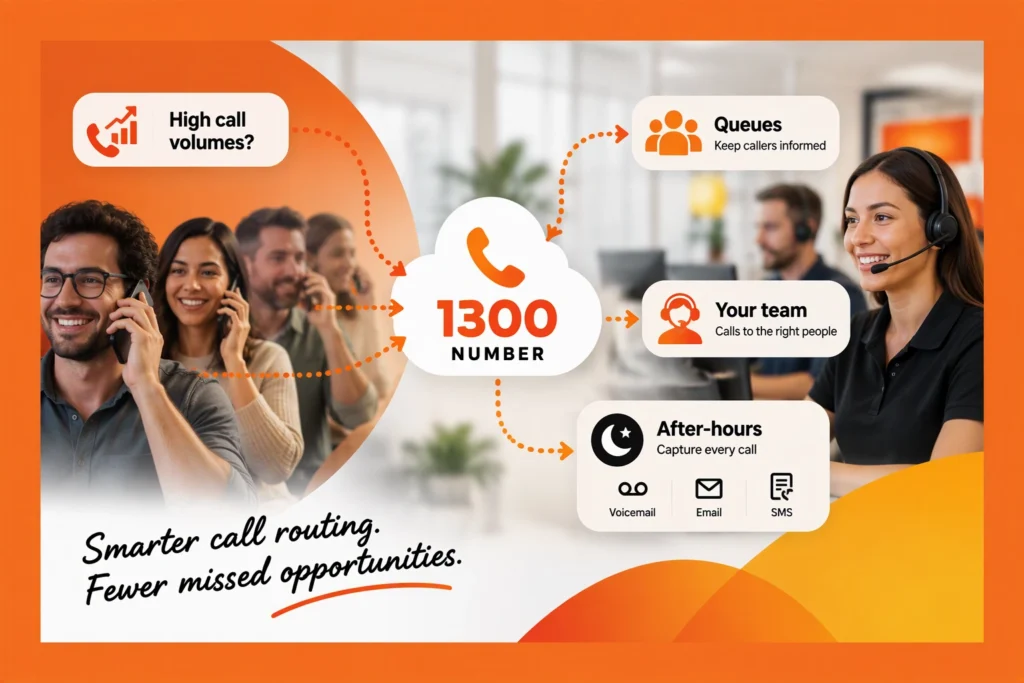
Late November and December are when many Victorian SMEs feel the phones heat up. Extra enquiries, shorter weeks, and public holidays can quickly stretch your team. The result is often avoidable: missed calls, long queues, and frustrated customers.
You do not need a complete phone system overhaul to fix it. A focused call-flow tune paired with the right numbers and resilient phones and internet will carry you through peak trading without chaos.
This playbook shows exactly what to adjust now so you answer more calls, protect sales, and keep service levels steady through the festive period.
Find your busiest hour and size the queue
Start with data. Pull the last 60 to 90 days of call logs to find:
- Busiest hour and day pattern
- Average speed of answer (ASA), abandonment rate, and peak concurrency
- Transfer paths that stall or loop callers
Then tune the queue and Automatic Call Distribution (ACD) around that busiest hour.
Practical steps:
- Set queue limits: cap waiting callers at a realistic number, then overflow to an alternate path such as a second team or voicemail-to-email.
- Choose a ring strategy: start with skills-based or longest-idle for support, linear-hunt for high-accountability lines, and round-robin or top-performers-first for sales if targets depend on speed to pick up.
- Right-size concurrency: if your peak shows eight simultaneous calls, plan for 10 to 12 to create headroom for transfers.
- Use queue callbacks sparingly: useful on days with long spikes, but test messaging first.
ACD in plain terms: it is the logic that places callers in the right queue and decides which available agent gets each call. It typically routes by skills, idle time, time-of-day, or priority.
Set clear overflow, then remove friction
Overflow rules save calls when queues back up:
- Time-based overflow: after 60 to 90 seconds, send callers to a secondary group.
- Capacity-based overflow: when the queue reaches its cap, route to voicemail-to-email or on-call mobiles.
- Priority lines: treat sales and urgent support differently. Sales should jump the queue or route to a tighter, faster ring group.
Minimise Interactive Voice Response (IVR) layers. Keep menus short with one confirmation. IVR is the front-door menu where callers choose options; call routing is the broader logic that moves calls through queues, ring groups, mobiles, voicemail, and schedules. Use IVR only to split clearly different intents such as sales vs service.
After-hours and holiday handling that works
Now is the time to record and schedule:
- Business-hours, after-hours, and public holiday greetings that set expectations.
- Voicemail-to-email with a monitored group inbox. Include caller number, recording, and queue context if available.
- On-call and mobile failsafe: create a dedicated rule for emergencies or VIP accounts. Use time windows and escalation so one device does not ring all night.
- Public holiday schedule: pre-load dates for late November and December and test the switch the week prior.
Missed call solution in practice: a combined setup of smart queues, voicemail-to-email, on-call routing to mobiles, and scheduled greetings. It reduces abandonment by giving callers a path to resolution even when no one is at a desk.
Use 1300, 1800 and virtual numbers to track and prioritise
Non-geographic numbers help during peaks:
- 1300: local-rate experience. Good for standard enquiries across Australia.
- 1800: toll-free for callers, typically used for sales, promotions, or urgent support.
- Virtual numbers: assign unique numbers to campaigns, pop-up sites, or regions, then route by priority and measure answer rates and conversion.
Tips:
- Point sales promos to a shorter IVR and faster ring strategy.
- Keep support numbers steady with skills-based routing and stricter overflow.
For Dandenong-based businesses wanting one national contact point, review options for business 1300 numbers and toll free numbers and match each to caller expectations.
Testing rhythm before peak
Do not wait for the rush. Run quick simulations each week until mid-December:
- Call-path walk-throughs for every menu option and overflow rule
- Failover drill: pull the primary link and verify 4G or 5G takes over cleanly for voice
- Number porting checks: if you recently ported, confirm in-bound from mobile, landline, and interstate callers
If your office depends on mobile failover, align it with your plan choice and coverage. You can explore business mobile phone plans in Cranbourne or review mobile broadband services options that pair cleanly with VoIP failover.
Metrics to watch daily
Keep a simple scoreboard visible and act on it at midday and close:
- Answer rate: aim for steady gains; adjust staffing or overflow when it dips.
- Abandonment rate: a spike suggests queue limits, greeting length, or ASA need attention.
- ASA: small reductions compound. Tighten ring strategy or add headcount in the busiest hour.
Why missed calls happen, and quick fixes
Common causes:
- Under-sized concurrency for the busiest hour
- Long IVR menus that cause drop-offs
- No overflow or slow overflow thresholds
- No voicemail-to-email or unmonitored inboxes
- Unplanned public holiday schedules
- Internet jitter or an untested failover path
Quick fixes:
- Shorten IVR and raise queue capacity with defined overflow
- Enable voicemail-to-email and monitor it throughout the day
- Add 4G or 5G failover and test it
- Split sales and support so sales get faster routing
- Use virtual numbers to isolate campaigns and staff accordingly
How phone call routing works, in one view
Phone call routing is the rules engine that decides where each call goes based on time, intent, caller input, and staff status. It blends:
- IVR front-door choices
- ACD queue placement
- Ring strategies inside teams
- Overflow to other users, sites, mobiles, or voicemail
- Schedules for business hours, after-hours, and holidays
FAQ
What are the different types of call routing?
Skills-based, longest-idle, round-robin, linear-hunt, time-of-day, and priority-based. Use IVR for initial intent capture, then ACD to allocate within teams.
How does phone call routing work?
A ruleset evaluates time, menu choices, and availability, then directs the call to queues, ring groups, mobiles, or voicemail with overflow and failover where needed.
What is the ACD routing system?
ACD places callers in queues and assigns them to the best available agent using rules such as skills, idle time, or priority.
What is the difference between call routing and IVR?
IVR collects caller input at the front door. Call routing is the end-to-end logic that moves calls through queues, overflow, mobiles, and schedules.
What is the missed call solution?
A practical bundle of queue tuning, voicemail-to-email, scheduled greetings, and on-call mobile routing that keeps callers moving when desks are busy or closed.
Why am I getting missed calls?
Usually, a capacity mismatch in your busiest hour, slow ring strategies, long IVR menus, no overflow, unmonitored voicemail, or an untested failover path.
Local, peak-ready actions you can take this week
- Map busiest-hour demand and raise concurrency with headroom.
- Separate sales and support flows.
- Enable voicemail-to-email and confirm the inbox is monitored.
- Pre-load late November and December holiday hours and greetings.
- Test 4G or 5G failover and confirm softphones and desk phones stay registered.
- Assign a virtual number to any promotion and measure answer rates daily.
If you need hands-on help aligning VoIP and numbers with resilient internet, you can review VoIP systems in Cranbourne and SIP options or ask for a local SIP trunk assessment. For mobility-backed failover, explore the best fit among business mobile phone plans in Cranbourne. If you operate across multiple sites around Victoria, consider a multi-site connectivity solution in Cranbourne to keep call quality consistent.
Summary and next step
With a few targeted changes, you can cut abandonment, lift answer rates, and keep holiday trading calm. Tune queues around your busiest hour, separate priority lines, load after-hours schedules, and test failover now. Book a pre-peak call-flow and resilience check with DSP for November and December trading in Victoria by contacting sales@dspcommunications.com.au